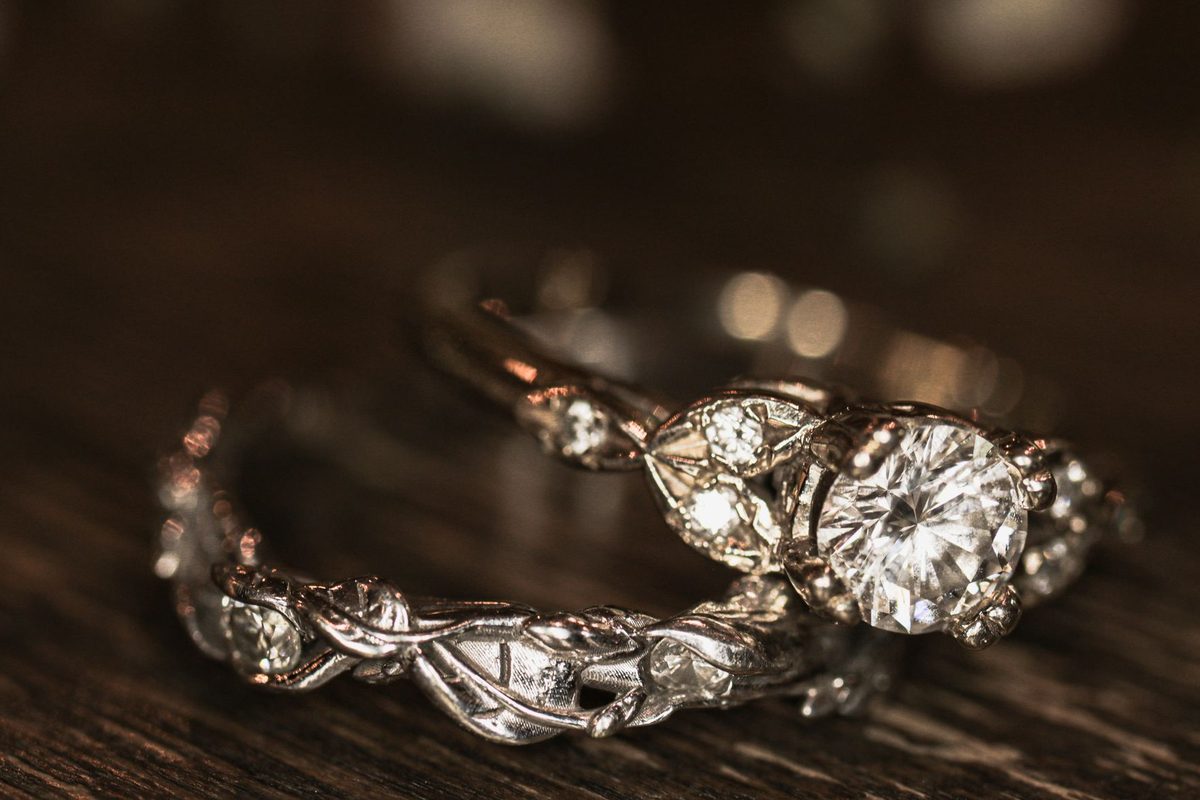
You are looking at two white stones that appear identical in the tray, and the price tags differ by a factor of three or more. Every sales floor will happily sell you either one — but few explain what you are actually choosing between, because "they look the same" is both true and not the whole story.
Here is the honest version. Across a dinner table, at normal conversational distance, essentially nobody can tell moissanite from a lab-grown diamond. The differences are real but subtle: how each stone handles light, how it is graded and documented, what it costs per carat, and what happens if you ever try to sell it. Those four things — not "can people tell" — are what should drive the decision.
Two Different Stones, Not Two Versions of One
The confusion starts with naming. A lab-grown diamond is diamond — the same carbon crystal, grown in a chamber instead of the earth. Moissanite is a different mineral entirely: silicon carbide, and effectively always lab-grown, because natural moissanite is so rare it was first identified in a meteor crater. They are not rivals for the same chemistry; they are two white stones competing for the same finger.
| Moissanite | Lab-grown diamond | |
|---|---|---|
| Composition | Silicon carbide (SiC) | Carbon — identical to mined diamond |
| Mohs hardness | 9.25 | 10 |
| Refractive index | 2.65–2.69 | 2.42 |
| Dispersion ("fire") | 0.104 — about 2.4x diamond's | 0.044 |
| Optical type | Doubly refractive | Singly refractive |
| Lab paperwork | Rarely graded by major labs | IGI or GIA report on the 4Cs |
| Typical price, ~1 ct size (loose) | $300–$700 | $800–$2,000 |
One sizing quirk: moissanite is sold by millimeter, not carat. It is less dense than diamond, so a 6.5 mm moissanite — the size that reads as "one carat" on the hand — weighs about 0.88 carats. When sellers say "1 ct DEW" they mean diamond-equivalent weight, not actual weight.
Fire vs Brilliance: Why the Sparkle Looks Different
Diamond's optical signature is mostly brilliance — white light returned to your eye — with modest colored flashes. Its refractive index of 2.42 and dispersion of 0.044 produce that crisp, icy look the whole industry is benchmarked against.
Moissanite bends light harder (RI 2.65–2.69) and disperses it far more (0.104). The result is more total sparkle and dramatically more rainbow. Under candlelight or restaurant spotlights this looks spectacular; in direct sunlight, some people find the colorful flashes read as a "disco ball" rather than diamond. Neither is objectively better — it is a taste call. If you love the cold white look, moissanite's fire may strike you as slightly off; if maximum sparkle is the goal, moissanite out-sparkles diamond.
Color is the other tell, mainly in larger stones. Premium moissanite is sold near-colorless, comparable to a D–F diamond. Cheaper or older material can show a faint yellow-gray-green cast that becomes more noticeable above roughly 2 carats and under warm indoor light. Lab diamonds carry real color grades on the standard D–Z scale, so you know exactly what you are buying.
Durability: Both Are Lifetime Stones
On the Mohs scale, lab diamond sits at 10 and moissanite at 9.25 — between sapphire (9) and diamond. Both land in the top tier of our everyday-wear durability ranking, and both are stones you can wear daily for decades without babying.
Two nuances worth knowing. Diamond has perfect cleavage in four directions — a sharp knock on exactly the wrong plane can chip it. Moissanite has no comparable cleavage problem, so in the narrow sense of chip resistance it is arguably tougher. And both shrug off cleaning: warm soapy water, a soft brush, and even the ultrasonic tank are safe for either stone, per our jewelry cleaning protocol. For the wider context of where these stones sit among other gems, the gemstone directory maps hardness against care requirements.
How a Jeweler — or a Tester — Actually Tells Them Apart
If dinner guests cannot tell, who can? A jeweler with a loupe and thirty seconds.
- Facet doubling. Moissanite is doubly refractive: look through the crown with a 10x loupe and the back facet edges appear doubled. Diamond is singly refractive — every edge stays crisp. This is the classic visual separation.
- Testers. Old thermal "diamond testers" measure heat conduction, and moissanite conducts heat nearly as well as diamond — it passes them. Modern dual testers add an electrical conductivity check: moissanite conducts a small current, diamond essentially never does. That second test is decisive.
- Paperwork. A lab diamond typically arrives with an IGI or GIA grading report covering cut, color, clarity, and carat. Moissanite generally does not carry major-lab documentation — you are buying the manufacturer's own quality grade instead.
Price and Resale Reality
The price gap is the main reason this comparison exists. A finished moissanite engagement ring typically runs $500–$1,500; an equivalent lab-diamond ring typically runs $1,500–$4,000, depending on size, grade, and metal. The same budget buys roughly two to three times the visual size in moissanite — a 2-carat look for the price of a modest lab stone.
Resale is the less comfortable truth: neither stone holds value well. Lab diamonds typically resell for a fraction of retail because production keeps getting cheaper; moissanite has essentially no secondary market at all. Buy either stone because you want to wear it for decades, not because it stores value — the heirloom case rests on sentiment and durability, not appraisal.
The Verdict by Budget
- Under about $1,000 all-in: moissanite, near-colorless grade, in the 6.5–8 mm range. You get a genuine lifetime stone and can put the savings into a better setting.
- $1,500–$4,000: lab diamond. You want the D–Z color grade, the independent certificate, and the classic white-light look — and this is the honest way to get "a real diamond" without the mined-stone premium.
- The heirloom test: if "it must be a diamond" matters to you, your partner, or your family, lab diamond answers it truthfully. If the sentiment matters more than the species of stone, moissanite is the rational buy and nobody at the table will ever know.
— Simply Jems Editorial Studio, Canadian artisan roots since 2014.
Frequently Asked Questions
Will moissanite pass a diamond tester?
It passes older thermal-only testers, because it conducts heat almost as well as diamond. Modern dual-mode testers add an electrical conductivity check — moissanite conducts a small current, diamond does not — and that separates them reliably.
Does moissanite go cloudy over time like cubic zirconia?
No. Silicon carbide does not cloud, and at 9.25 Mohs it resists the surface scratching that dulls CZ. What looks like cloudiness is almost always soap and lotion film, which a warm soapy-water bath removes.
Is a lab-grown diamond a real diamond?
Yes. It is the same carbon crystal with the same hardness, refractive index, and fire as a mined stone, and labs like IGI and GIA grade it on the identical 4Cs. The only difference is origin: weeks in a growth chamber instead of a billion years underground.