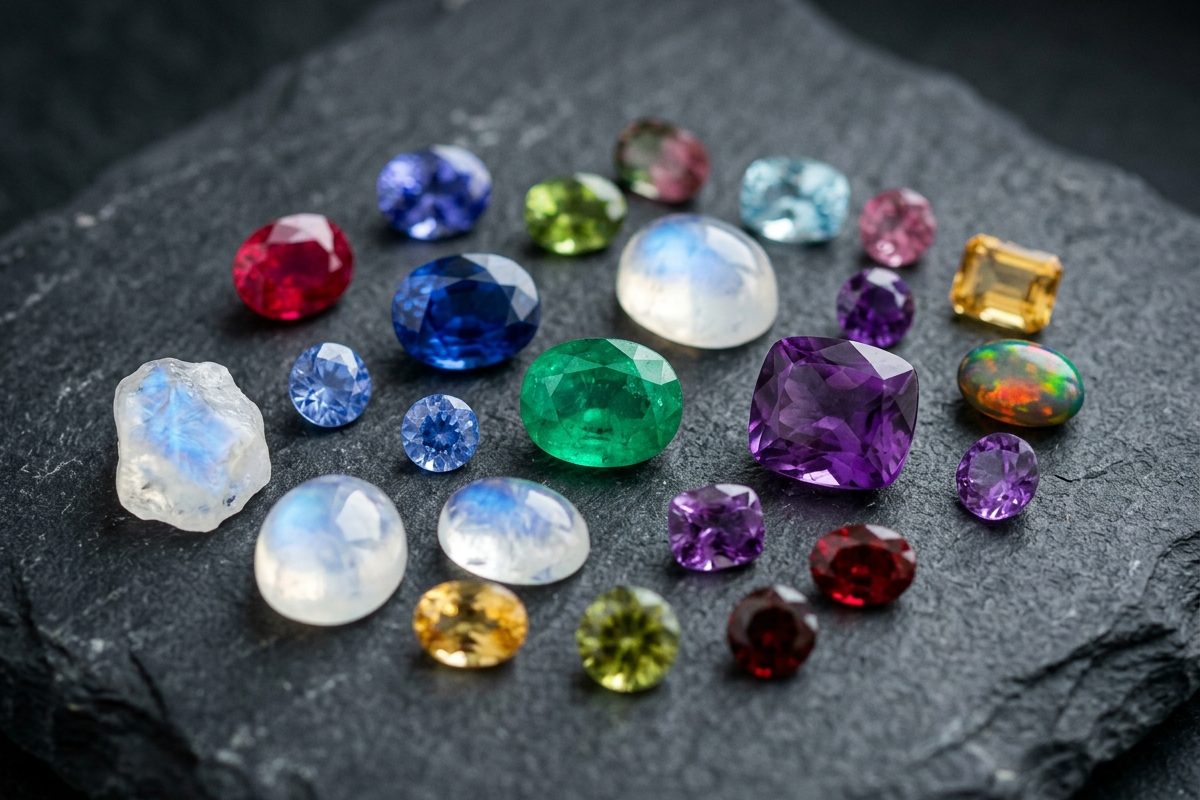
You work with your hands. You type, garden, lift, wash dishes, and you want a ring that stays on through all of it without turning into a scratched, chipped regret. This is the most common durability question we get, and the honest answer is narrower than most jewelry marketing suggests.
Only a handful of gemstones genuinely tolerate decades of daily ring wear. The rest are beautiful stones assigned to the wrong job — better suited to pendants, earrings, or occasional-wear rings. This guide ranks them plainly, then shows you how to cheat the rules safely when your heart is set on a softer stone. For cleaning and long-term maintenance once you own the piece, see our care and cleaning protocol.
Why Hardness Alone Isn't the Whole Story
Mohs hardness measures scratch resistance — how well a surface resists abrasion. It is the number everyone quotes, but two other properties decide whether a stone survives your life:
- Toughness is resistance to chipping and breaking. Diamond is the hardest material on earth (10 Mohs) yet has perfect cleavage — a sharp knock along the right plane can split it. Jadeite jade, barely 6.5–7 Mohs, is among the toughest gem materials known and shrugs off blows that would chip an emerald.
- Stability is resistance to heat, light, chemicals, and water. Opal is not fragile because it is soft alone; it is fragile because it dries, crazes, and hates temperature swings. Emerald is often internally fractured and frequently oiled, which is why ultrasonic cleaning ruins it.
A good everyday stone scores well on all three axes. Keep that in mind reading the tiers below — and check our gemstone directory for the cleaning method each mineral tolerates.
Everyday-Wear Tiers
| Tier | Gemstones | Mohs | Daily-wear verdict |
|---|---|---|---|
| Tier 1 — Set and forget | Diamond, lab diamond | 10 | The benchmark; only cleavage knocks threaten it |
| Tier 1 — Set and forget | Sapphire, ruby | 9 | No cleavage, superb toughness; arguably the best daily colored stones |
| Tier 1 — Set and forget | Moissanite | 9.25 | Best value in the top tier; daily wear is its home turf |
| Tier 2 — Excellent daily stones | Chrysoberyl, alexandrite | 8.5 | Underrated; genuinely ring-worthy |
| Tier 2 — Excellent daily stones | Spinel | 8 | Tough, stable, no cleavage; a jeweler's favorite sleeper pick |
| Tier 3 — Daily with care | Aquamarine | 7.5–8 | Fine daily, but avoid hard knocks; edges can abrade |
| Tier 3 — Daily with care | Topaz | 8 | Hard but has perfect cleavage — one bad hit can split it |
| Tier 3 — Daily with care | Tourmaline | 7–7.5 | Wearable daily if you accept slow surface wear |
| Tier 4 — Occasional rings | Garnet | 6.5–7.5 | Scratches accumulate; better in protected settings |
| Tier 4 — Occasional rings | Amethyst, citrine | 7 | Quartz handles life okay but dulls over years of abrasion |
| Tier 4 — Occasional rings | Peridot | 6.5–7 | Lovely, soft; keep it for evenings |
| Tier 4 — Occasional rings | Tanzanite | 6.5 | Cleavage plus softness — a once-a-week stone |
| Tier 5 — Not for daily rings | Emerald | 7.5–8 | Hard but brittle and often oiled; a protected-setting-only stone |
| Tier 5 — Not for daily rings | Opal | 5.5–6.5 | Porous, soft, unstable — wear it on a pendant |
| Tier 5 — Not for daily rings | Moonstone | 6–6.5 | Cleavage and softness; gorgeous, fragile |
| Tier 5 — Not for daily rings | Pearl | 2.5–4.5 | Organic; perfume and abrasion destroy nacre |
| Tier 5 — Not for daily rings | Turquoise | 5–6 | Porous, absorbs oils and chemicals |
For the folklore and meaning behind these stones, our gemstone meanings guide covers the lore side of the same list.
Do / Don't for Daily Rings
| Do | Don't |
|---|---|
| Choose Tier 1–2 stones for a never-off ring | Put opal, pearl, or turquoise in a daily ring |
| Pick a bezel or low-profile setting for Tier 3–4 | Use tall, exposed prongs on a soft stone |
| Remove the ring for the gym, garden, and pool | Wear it while lifting weights or handling tools |
| Clean with warm soapy water and a soft brush | Ultrasonic-clean emerald, opal, tanzanite, or pearl |
| Get prongs inspected yearly by a jeweler | Assume a setting that held a diamond suits a softer gem |
Settings Matter as Much as the Stone
A 7 Mohs stone in a full bezel outlives a 9 Mohs stone in a tall cathedral prong. The setting decides how much of the girdle — the stone's most chip-prone edge — is exposed to door frames and countertops.
- Bezel settings wrap the girdle in metal and are the single best upgrade for any Tier 3–5 stone. Prong settings maximize sparkle but leave the girdle naked; fine for Tier 1.
- Low-profile designs keep the stone below the knuckle line, cutting the number of impacts dramatically. A stone you hit fifty times a day fails; one you hit twice a week lasts.
- Metal choice: platinum and 14k gold hold stones more securely than 18k gold, which is softer and lets prongs wear faster. For a workhorse ring, 14k is the practical sweet spot.
If You Love a Soft Stone Anyway
You are not banned from opals — you are just advised to give them a safer job. A pendant or pair of earrings exposes a stone to a fraction of the trauma a ring takes; pearls and opals live long, happy lives there. If it must be a ring: rotate it rather than wearing it daily, insist on a protective bezel or halo setting, and treat removal-for-chores as non-negotiable. Treated that way, even a moonstone ring can last decades.
— Simply Jems Editorial Studio, Canadian artisan roots since 2014.
Frequently Asked Questions
Is moissanite good for daily wear?
Yes — excellent. At 9.25 Mohs it sits just below diamond, has no cleavage problem in normal wear, and costs a fraction of a diamond. It is one of the best-value everyday stones available.
Can I wear an opal ring every day?
We advise against it. Opal is 5.5–6.5 Mohs, porous, and sensitive to impact and sudden temperature changes. If you must, choose a low-profile bezel setting and remove it for hands-on work — or move opal to a pendant where it thrives.
Sapphire or diamond for an engagement ring you never take off?
Both are top-tier choices. Diamond is harder (10 vs 9) but has perfect cleavage; sapphire has no cleavage and is effectively indestructible in daily wear. Pick by budget and color preference — durability is a tie in practice.