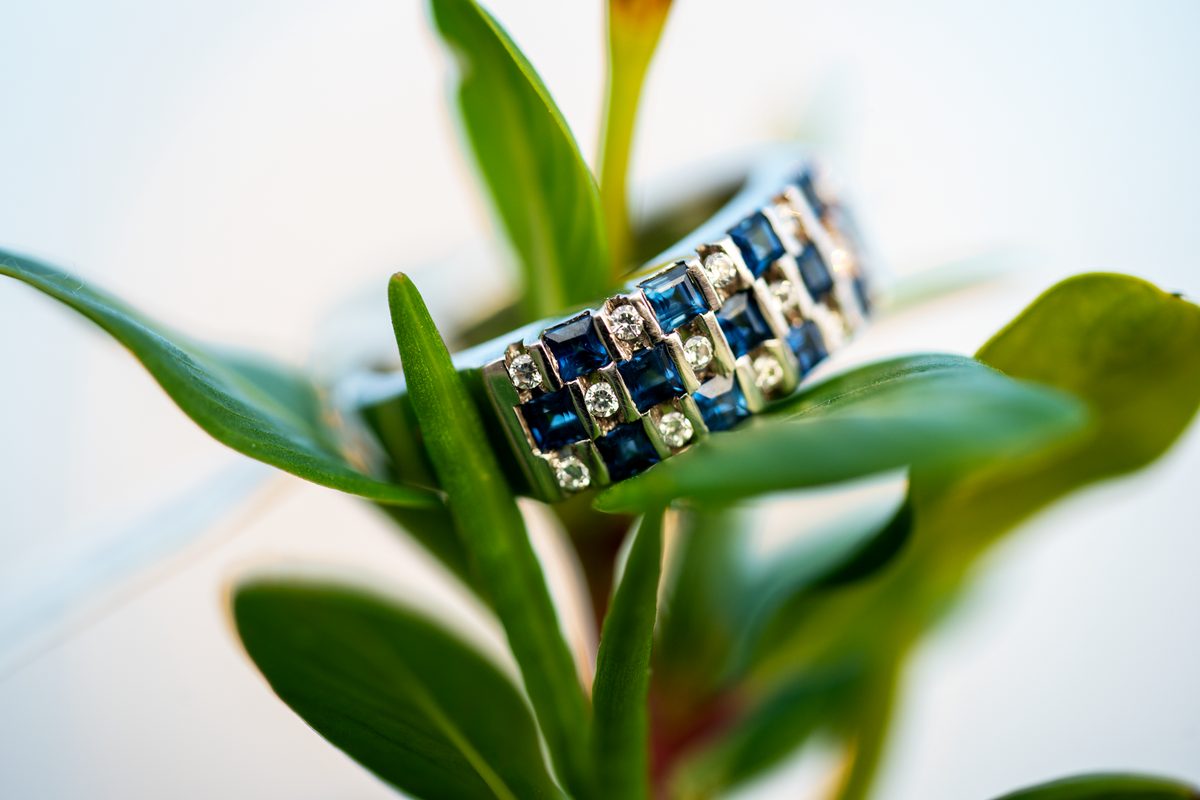
You find two blue sapphire rings: one costs a few hundred dollars, the other several thousand. Both sellers promise a genuine stone, both rings look convincing, and the cheaper one is labeled lab-created. The question is whether that label means a weaker ring or simply a different origin.
For ordinary wear, origin alone does not decide durability. What you pay for changes, though: a grown crystal offers accessible color, while a natural stone carries geological rarity and a market shaped by quality and treatment. Here is how to compare them without letting a rich blue photograph make the whole decision.
Same corundum, different origin
Sapphire is corundum, aluminum oxide; blue color usually comes from trace iron and titanium. Natural corundum formed in the earth. Lab-created corundum grows under controlled conditions through methods such as flame fusion, flux growth, or crystal pulling. The result is sapphire, with essentially the same properties as its natural counterpart.
That distinction matters when a listing says sapphire-colored, simulated sapphire, or sapphire crystal. A blue simulant may be glass or another mineral. Ask the seller to identify the material, rather than interpreting a color name as a mineral guarantee.
| Question | Lab-created sapphire | Natural sapphire |
|---|---|---|
| Material | Synthetic corundum | Naturally formed corundum |
| Mohs hardness | 9 | 9 |
| Blue color | Can be produced consistently | Varies between individual stones |
| Inclusions | Growth-method dependent; may be very clean | Natural crystals, silk, fractures, or other features may occur |
| Main price drivers | Growth method, cutting, size, seller | Color, size, cutting, treatment, rarity, sometimes geographic origin |
| Buying paperwork | Written lab-created disclosure; testing if identity is uncertain | Written treatment disclosure; independent report when value warrants |
Both sit at the sapphire rating in our gemstone hardness and care directory. Neither is scratch-proof: diamond can scratch sapphire, and a sharp impact can chip an exposed edge. A low setting and sound prongs matter whichever origin you choose; our everyday gemstone buying guide explains hardness, toughness, and protection.
Judge color and cutting before the label
Start with the stone face-up in diffuse daylight, then move to ordinary indoor lighting. A blue that looks vivid under a jewelry counter spotlight can look nearly black in your kitchen. Very pale material may lose the saturated look you wanted once set beside white metal.
Watch for a window: a transparent patch through the center where you see the background instead of reflected color. Also look for large dark areas that stay dark as you tilt the stone. Some shifting contrast is normal; a lifeless center is a reason to compare another cut.
Ask for millimeter dimensions as well as carat weight. Two sapphires weighing 1 carat can face up differently because one carries more weight beneath the setting. Compare actual width and length, not just the weight on the tag.
Clean appearance proves neither quality nor lab origin. Some natural sapphires are eye-clean; some lab-created stones have visible growth features or inclusions. Conversely, a visible inclusion does not automatically mean poor durability. A surface-reaching fracture near a prong deserves more attention than a tiny enclosed crystal.
Treatments and reports: what to ask for
Natural does not mean untreated. Heating is common in natural sapphire and can improve color or clarity. Heat treatment does not make the stone lab-created. Other processes, including lattice diffusion, fracture filling, or coating, raise different questions about value, color depth, and care.
Ask for the exact treatment description in writing. With diffusion-treated material, ask whether color is shallow or penetrates the stone, and whether repolishing could change its appearance. A filled stone needs care advice specific to its filler; avoid assuming every sapphire tolerates steam or ultrasonic cleaning.
For a costly natural stone, consider an independent colored-stone report from an established laboratory such as GIA. Read the findings yourself: identification, natural or synthetic origin, and detected treatments are more useful than a seller's impressive certificate heading. A geographic-origin opinion, when available, is a separate finding with its own limits.
A report is not an appraisal, a resale promise, or a diamond-style 4Cs grade. Check the report number through the issuing laboratory and compare the stated dimensions and weight with the stone offered. For a mounted ring, ask what the setting prevents the examiner from assessing.
In the United States, the FTC Jewelry Guides address clear disclosure of laboratory creation and treatments in specified circumstances. Ask for an invoice that says lab-created sapphire when appropriate and records relevant treatments; rules vary by market, so do not rely on a verbal assurance alone.
Price and resale: compare like with like
Lab-created sapphire typically costs much less than natural material of comparable visual size and color. Flame-fusion stones are inexpensive to produce; flux-grown material and careful custom cutting can cost considerably more. A lab-created ring's price may therefore depend heavily on its gold weight, craftsmanship, accent stones, and retailer.
Natural sapphire has no useful single price per carat. A dark, commercial-quality heated stone and a vivid, well-cut untreated stone are different purchases even at the same weight. Collect at least three current quotes with the same dimensions, treatment category, and metal before deciding a price is fair.
Compare loose stones separately from finished rings where possible. A lab-created sapphire in a well-made 14k gold ring can be a better everyday purchase than a more expensive natural stone in thin, worn prongs. Include resizing, maintenance, and any report fee in your budget.
Expect little resale value from an ordinary lab-created sapphire itself. Some exceptional natural sapphires have collector demand, but an ordinary retail purchase still includes margins that resale may not recover. An insurance replacement appraisal is not a cash offer. Buy for wear and sentiment; obtain actual dealer offers if resale is central to the decision.
A buying decision you can use at the counter
Choose lab-created when you want blue corundum, daily durability, and more budget for the setting. Choose natural when geological origin is part of the pleasure and you accept paying for documented quality. Choose neither yet if the seller cannot clearly identify the stone or explain its treatments.
| Do | Don't |
|---|---|
| Compare color in daylight and normal indoor light | Buy from one heavily edited photograph |
| Request millimeter dimensions and written disclosure | Treat carat weight or a blue color name as sufficient |
| Match report details to the stone | Assume every seller certificate is independent |
| Inspect prongs, girdle protection, and return terms | Spend the entire budget on origin and neglect the setting |
Before payment, confirm the return window is long enough for an independent inspection. Once home, follow the treatment-specific care instructions; lukewarm soapy water and a soft brush suit ordinary unfilled sapphire in a compatible setting. Store it separately from diamonds and softer stones, and remove the ring for lifting weights or handling tools. Origin is a purchase preference; careful ownership protects either choice.
— Simply Jems Editorial Studio, Canadian artisan roots since 2014.
Frequently Asked Questions
Is lab-created sapphire a real sapphire?
Yes: it is synthetic corundum with essentially the same chemical, physical, and optical properties as natural sapphire. Blue glass or cubic zirconia sold as a sapphire look-alike is a simulant, which is a different material.
Can you tell natural sapphire from lab-created sapphire by eye?
You cannot reliably establish origin from color or apparent clarity alone. A gemologist examines growth features and inclusions, sometimes with advanced testing, and an independent laboratory can issue an identification report.
Does lab-created sapphire scratch or fade more easily?
Lab-created and natural corundum both have Mohs hardness 9, so lab origin does not inherently make sapphire softer. Ask about any treatments or coatings, and protect either stone from impacts and unsuitable cleaning methods.