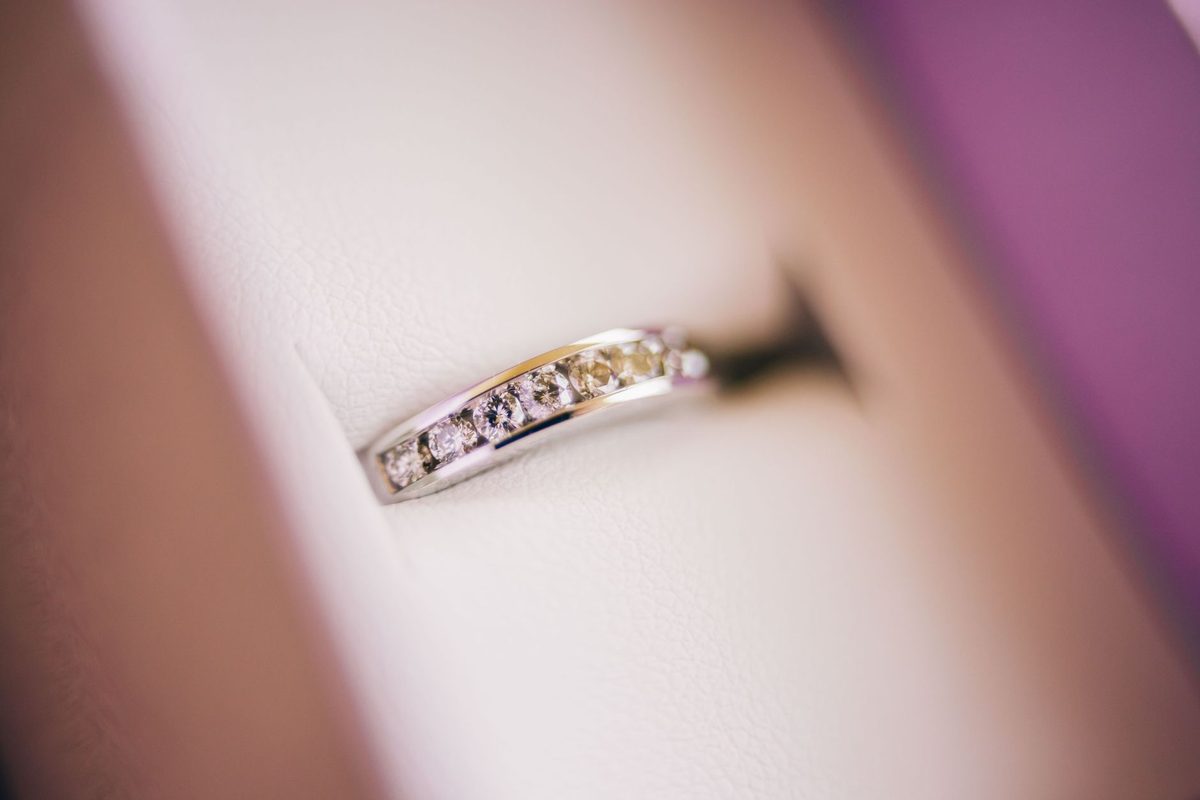
You notice a faint rattle, a prong catches your sleeve or the center stone looks tilted. The ring still looks mostly normal, and you wonder whether it can wait until the next cleaning appointment. The useful response is to stop wear and preserve the piece while a jeweler checks its support.
A setting problem is separate from a gemstone's hardness. This guide explains which observations help, what to avoid at home and how to discuss repair. Our everyday gemstone guide explains why scratch resistance alone does not make a whole ring indestructible.
What are the signs of a loose ring stone?
Look at the piece in good light and compare it with an earlier photograph if you have one. Note whether a stone sits differently, one prong looks shorter or a part has begun catching. Describe what changed rather than deciding that a particular prong must be bent back.
A ring can use claws, a bezel, a channel or other supporting features. Some small stones are held by metal that is difficult to inspect without magnification and experience. The absence of an obvious claw does not mean the stone has no mechanical support to assess.
GIA's diamond ring protection guide discusses setting condition and stone security as part of care. That is a reason to request inspection when something changes, not permission to repeatedly push or shake the piece until you prove movement.
Do not drag fabric over prongs as a deliberate snag test. If the ring already catches during ordinary wear, that observation is enough to mention. Similarly, a rattle is worth reporting, but repeated tapping adds no useful owner-level diagnosis.
How should you protect a loose stone and ring?
Remove the ring safely and put it alone in a small padded container. Keep it out of a mixed jewelry dish where other pieces can strike it. Label the container with the observed problem so nobody mistakes it for a ring ready to wear.
Do not clean it before the appointment. Dirt can hide wear, but cleaning an uncertain setting can also complicate a loose-stone problem. Ask the jeweler whether controlled cleaning is needed as part of assessment. Our cleaning guide applies to suitable sound pieces, not as a repair method.
| Observation | Immediate action | Information to keep | Avoid |
|---|---|---|---|
| Stone moves or tilts | Stop wear and isolate the ring | When noticed and recent knocks | Pushing it back into place |
| New snagging prong | Arrange setting inspection | Which part catches | Pliers or bending experiments |
| Stone is missing | Keep the ring and any recovered stone separately protected | Photographs and stone report | Adding a replacement before assessment |
| Visible chip or fracture | Stop wear and request gem/setting review | Location and apparent change | Scratching, polishing or ultrasonic cleaning |
| Ring was recently altered | Contact the repairer with observations | Receipt and agreed work | Assuming the old inspection still covers it |
If a stone has come out, keep it in a closed padded container rather than loose in paper that can be discarded. Do not tape directly across its surface. If it is missing entirely, preserve the ring and records; the empty setting can still show what repair is needed.
Why does the whole setting matter?
Daily wear can affect the metal that supports a stone. A knock, worn tip or distorted band can change how the setting holds it. One visible symptom may therefore need assessment of more than one small part.
GIA's diamond chipping guidance distinguishes hardness from toughness and discusses protection of vulnerable stone areas. A diamond at Mohs 10 resists scratching very well, but that does not make impacts harmless. Its setting needs to suit both the stone and the way it is worn.
For mixed rings, ask whether the jeweler sees concerns in small surrounding stones as well as the center. A repair that only addresses the obvious movement can miss adjacent wear. Our diamond entry in the gemstone directory gives material context, while the bench inspection determines the work for your actual piece.
Do not approve stronger-looking prongs purely from a drawing. A different setting may change appearance, cleaning access or the fit of another band. Ask which repair preserves the original design and when rebuilding the support is a sounder option.
What should you ask about a repair?
Bring the receipt, previous repair history, photographs and any gem report. Tell the jeweler about a recent resize or impact, but do not assume it caused the problem. The assessment should connect observed wear or damage with the proposed repair.
- Ask the jeweler to identify which supports are unsound and whether the band or setting is distorted.
- Discuss whether the stone itself has damage that affects resetting or repair.
- Request a description of tightening, rebuilding, replacing or remaking work as separate options where appropriate.
- Ask whether stones need removal and whether the surface finish or engraving will change.
- Agree a quote and the process for approving additional work if more wear appears during inspection.
- Ask what final security and finish checks are included before collection.
Request an itemized estimate before comparing fees. Tightening, replacing worn supports and reconstruction are different jobs; a replacement gem may be a separate cost.
The original maker may understand a specialized design best. An independent bench jeweler may offer another sound approach. The case against choosing solely by the lowest quote is that one may include only tightening while another replaces worn support; compare the finished condition and explained method.
What should you check after repair?
At collection, ask the jeweler to show the completed work and explain any limitation that remains. Check for sharp edges, altered fit and a finish that differs from the agreement. Ask about nearby settings and whether another inspection is recommended for your wearing pattern.
Do not test the repair by bending prongs or pushing hard on the stone. A professional security check is part of the handover. If catching, movement or a changed position returns during ordinary wear, stop and take it back for assessment.
Remove the ring for activities that apply pressure, blows or unsuitable chemicals. Store it separately when off, following our storage guide. A protected resting place is more useful than taking the ring off and dropping it beside other hard stones.
Keep the repair record with the ring's photographs. Review inspection needs after significant impacts or changes in wear rather than relying on a universal calendar. The goal is a sound setting supported by sensible use, with changes noticed early and assessed before the ring returns to daily wear.
— Simply Jems Editorial Studio, Canadian artisan roots since 2014.
Key facts
- Diamond: Mohs 10; toughness: Can chip or cleave under a sharp blow despite its exceptional scratch resistance.; cleaning: For a sound, suitable piece, use warm soapy water and a soft brush. Check treatments and setting before any machine cleaning.
Sources
- GIA: Protect your diamond engagement ring (retrieved )
- GIA: Protecting diamond from chipping (retrieved )
Frequently Asked Questions
Can I keep wearing a ring with a slightly loose stone?
Set it aside until a jeweler assesses the setting. Small visible movement does not tell you how much support remains or what the next knock might do.
Should I push every stone to check it is secure?
Do not force or repeatedly probe a setting. Record visible changes and catching parts, and let a jeweler perform the mechanical assessment.
Can glue hold the stone until my appointment?
Do not add glue to a setting that was not designed for it. Keep the ring and any recovered stone together in a protected container so the jeweler can inspect the original problem.