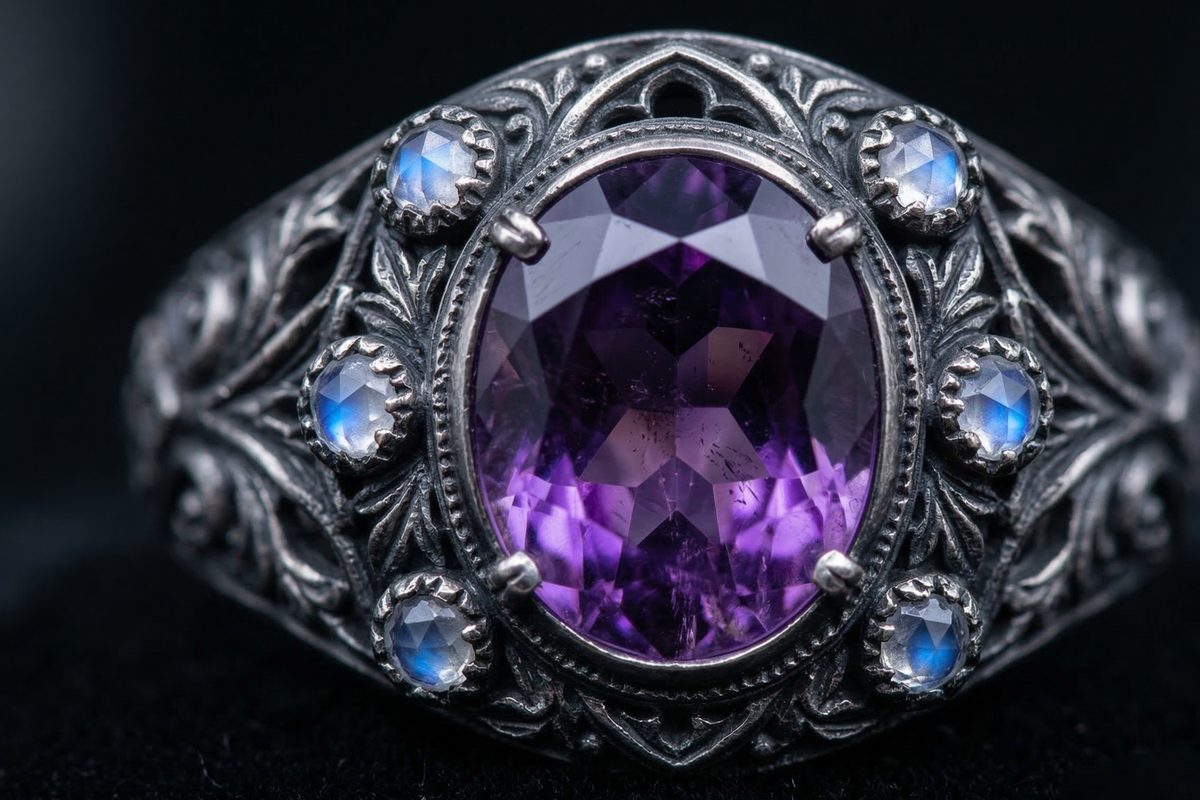
The pale glow of a moonstone ring can make it tempting to wear every day. But if the ring meets a countertop, a gardening tool or a gritty gym handle, its beauty does not tell you how well the stone will cope.
Moonstone is wearable jewelry, not an indestructible ring stone. GIA describes it as having poor toughness as well as moderate scratch resistance; a protective setting and a habit of taking the ring off for rough tasks matter more than a promise that it will survive everything. Our moonstone directory entry provides a quick reference, while this guide helps you decide what those facts mean for your hands.
What do hardness and cleavage mean for a moonstone ring?
GIA's moonstone care guide puts moonstone at 6–6.5 on the Mohs scale. Mohs hardness describes resistance to scratching, not resistance to a blow. Quartz is 7, so gritty material containing quartz can scratch a moonstone's exposed surface. A cloth with trapped grit can also abrade the stone: use a clean, soft one rather than rubbing away a mark with a dusty sleeve.
Toughness is a separate property: it concerns resistance to breaking and chipping. GIA describes moonstone's toughness as poor and says it has two cleavage directions. Cleavage is a direction of weakness in the crystal structure along which a stone is more likely to break. A hard knock can therefore do more than leave a surface scratch. A ring sits on a working hand, where the stone can strike handles, tables and other hard surfaces.
Do not try to demonstrate hardness by scratching the ring. A seller's description, a gemological report or an identification examination is more useful than a test that damages the piece. The everyday gemstone guide compares scratch resistance with the other qualities that make a ring practical.
How does moonstone compare with other ring stones?
Choose for the way you actually use your hands, not just for a number. The table gives a cautious starting point; treatments, stone condition and the setting also matter.
| Stone | Mohs hardness | Practical ring choice |
|---|---|---|
| Diamond | 10 | Strong scratch resistance; the stone and setting can still be damaged by a blow. |
| Sapphire or ruby | 9 | More scratch-resistant than moonstone; remove for rough work. |
| Garnet | 6.5–7.5, depending on type | Can suit careful regular wear, but abrasion and hard blows remain concerns. |
| Moonstone | 6–6.5 | Better as an occasional ring by default; protect from grit and knocks. |
| Opal | 5–6.5 | Choose a protected setting and limit rough wear. |
GIA's garnet care guidance gives that group a range because different garnets have different hardness. The garnet ring guide explains the trade-offs for that stone. A tougher or harder alternative may fit a hands-on routine better, but neither a sapphire nor a diamond makes its prongs immune to wear.
A pendant or earrings can be a good way to enjoy moonstone with fewer hand impacts. That is a risk reduction, not a promise of safety: any piece can be dropped, scraped in storage or exposed to unsuitable cleaning. If the ring is sentimental, rotating it with another band on active days can preserve the design without requiring an immediate reset.
Which setting offers a moonstone more protection?
Look for a setting that surrounds vulnerable edges and keeps the stone close to the finger. A full bezel has a rim of metal around the stone's edge; a partial bezel covers only some of that edge. Either can shield covered areas from some contact, but the top remains exposed. A low profile can also reduce the chance of catching the ring on a door frame or desk.
A tall prong setting may show more of the gem from the side, yet it leaves more of its edge exposed. A protective design still needs enough metal to hold the particular stone securely, and the setting must not put unnecessary stress on a vulnerable gem. Ask the maker how the stone is secured and what the design can realistically protect. Compare the side profile as well as the face-on photo when buying online.
Moonstone is often cut as a rounded cabochon to display adularescence, the floating light effect described in GIA's moonstone overview. View the ring in more than one ordinary lighting condition and from different angles: the effect moves with the viewing angle. A stronger blue sheen is an appearance preference, not proof that the stone is harder or more resistant to a knock.
Before buying, request the stone's identity, any known treatments and care instructions in writing. Ask about returns if the setting does not suit your hand, and check for visible chips or a stone that sits unevenly. A photograph alone cannot establish a gem's identity or the condition of its setting.
When should you take the ring off?
Remove it before gardening, lifting weights, moving boxes, cleaning with abrasive products or doing repairs. Also take it off before activities where the hand can strike another hard surface. Place it in a lined box or separate pouch before starting, not beside an open drain or loose in a pocket with keys.
For a daily ring, the decision is a compromise. An office day with limited handling exposes the stone differently from repeated lifting or tool work, and an individual routine can change. If you prefer a ring that stays on during every task, a more scratch-resistant choice is likely a better fit. If you prefer moonstone's glow, accept that you may need to remove it regularly and that accidental damage remains possible.
Keep moonstone away from harder jewelry in storage. A separate padded compartment prevents pieces rubbing against each other, and a closed container reduces contact with grit. Avoid high heat and sudden temperature changes: GIA says either can cause breaks. Do not leave the ring in a hot car or put a cold stone into hot water.
How should you clean and inspect a moonstone ring?
GIA recommends warm soapy water for moonstone and never recommends ultrasonic or steam cleaners. For a sound ring whose metal, setting and other components can tolerate water, use a small bowl of comfortably warm water and a little mild soap. Gently clean accessible surfaces with a soft cloth, rinse in a second bowl of similar-temperature water, and pat dry. Work over a padded surface, not an open drain; avoid pressing on the stone or pulling a cloth against prongs.
If the ring contains adhesive, another sensitive gem or an unknown treatment, check the maker's instructions before wet cleaning. A brief gentle wipe is a cautious starting point for an uncertain piece. Skip abrasive powders, toothpaste, solvents and sudden changes in water temperature. A machine labeled safe for jewelry is not automatically safe for moonstone: see our ultrasonic cleaner safety guide.
Look at the ring in good light after wear, without pushing the stone or deliberately snagging its setting. If a stone moves, a prong catches, or a chip or new line appears, stop wearing and cleaning it. Put the ring and any recovered fragment in a padded container and follow the loose-stone checklist before arranging an assessment. Surface dullness may be wear rather than dirt, and harder scrubbing cannot safely establish the difference.
— Simply Jems Editorial Studio, Canadian artisan roots since 2014.
Key facts
- Diamond: Mohs 10; toughness: Can chip or cleave under a sharp blow despite its exceptional scratch resistance.; cleaning: For a sound, suitable piece, use warm soapy water and a soft brush. Check treatments and setting before any machine cleaning.
- Sapphire: Mohs 9; toughness: Excellent toughness; corundum has no cleavage.; cleaning: Use warm soapy water and a soft brush for a sound piece; filled or dyed material needs particular care.
- Ruby: Mohs 9; toughness: Excellent toughness; corundum has no cleavage.; cleaning: Use warm soapy water and a soft brush for a sound piece; avoid machines for filled or dyed material.
- Moonstone: Mohs 6–6.5; toughness: Poor toughness; two cleavage directions make knocks a concern.; cleaning: Use warm soapy water and a soft brush for a sound, identified piece; avoid ultrasonic and steam cleaners.
- Opal: Mohs 5–6.5; toughness: Very poor to fair; protect against scratches and knocks.; cleaning: Some known solid opals can be cleaned gently with warm soapy water, but hydrophane can absorb liquids and should be kept dry. For unknown or assembled opal, use a soft dry cloth and seek piece-specific advice; avoid soaking, steam and ultrasonic cleaning.
- Garnet: Mohs 6.5–7.5; toughness: Fair to good, depending on the gem; avoid hard blows.; cleaning: Use warm soapy water and a soft brush for a sound piece; avoid steam and check for fractures or treatment.
Sources
- GIA: Moonstone care and cleaning (retrieved )
- GIA: Moonstone description (retrieved )
- GIA: Garnet care and cleaning (retrieved )
Frequently Asked Questions
Can I wear my moonstone engagement ring every day?
You can, but moonstone is more vulnerable to scratches and hard blows than sapphire or diamond. A low protective setting and removing the ring for rough work help reduce exposure, not eliminate it.
Can a scratched moonstone be repolished?
A lapidary may be able to repolish some surface wear, but the result depends on the stone, its condition and the setting. Repolishing removes material and does not guarantee that a chip or internal break can be repaired.
Can moonstone go in an ultrasonic cleaner?
No. GIA recommends warm soapy water for moonstone and does not recommend ultrasonic or steam cleaning. Check that the setting and other components can also tolerate the method.